

A complete guide to understanding two of the most popular gelling agents — what they are, how they work, and which one to choose.
If you’ve ever browsed the baking aisle or searched online for dessert ingredients, you’ve probably seen both jelly powder and fish gelatin powder — sometimes side by side, sometimes sold as the same thing. They’re not identical, and choosing the right one can make a real difference in your recipes.
This guide breaks down exactly what each product is, how they differ, and when to use each one.
01 · Overview
What is jelly powder?
Jelly powder is a ready-to-use gelling mix that typically contains a base thickener (such as carrageenan), plus pre-added flavorings, colorings, and sweeteners. Because everything is already blended in, you only need to dissolve it in hot water and let it set — no additional flavoring required.
It’s the shortcut option: fast, convenient, and great for making classic fruit-flavored jellies without any guesswork.
Quick definition
Jelly powder = gelling agent + pre-mixed flavors. Just add water, heat, and chill.
02 · Overview
What is fish gelatin (gelatine powder)?
Fish gelatin — also called gelatine powder, gelatin powder, or by its French-origin brand name “Gélatine” — is a pure protein extract derived from animal collagen (most commonly from fish skin and bones). In its pure form, it contains no flavors, no colors, and no additives.
Its English name is gelatine, and in Asian cooking contexts, it is often called 吉利丁粉 (jí lì dīng fěn) or simply fish gelatin powder.
Fish gelatin is 100% protein — no starch, no fat, and virtually no calories. It’s also one of the richest dietary sources of collagen peptides, supporting skin elasticity and joint health.
Food Science Note
03 · Comparison
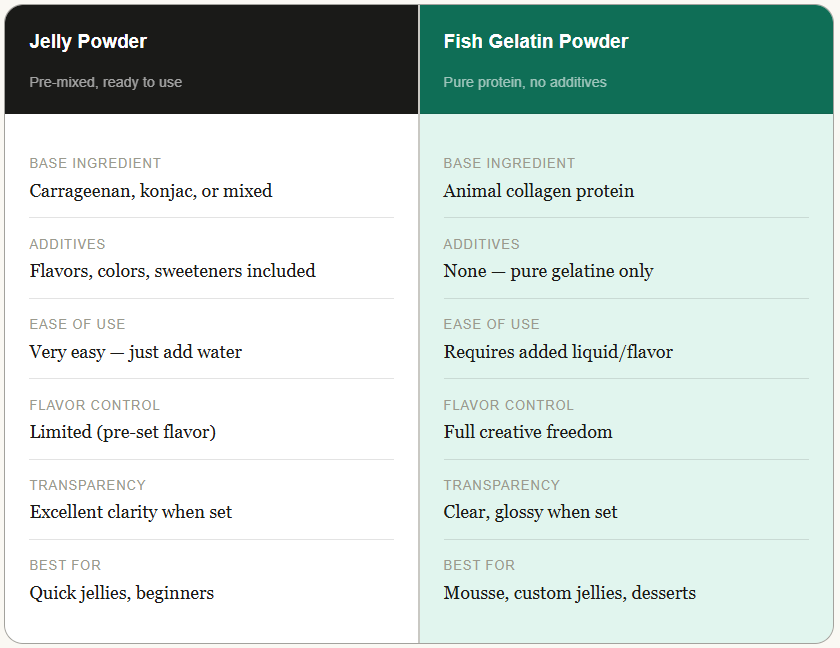
Key differences at a glance
Here’s a direct comparison of the two ingredients across the most important factors:
04 · Ingredients
What’s actually inside commercial jelly powder?
Carrageenan
Derived from red seaweed. Creates firm, clear gels and gives jellies their glass-like transparency.
Xanthan Gum
A fermentation-derived thickener that improves stability and prevents the jelly from weeping liquid over time.
Konjac Flour
Made from the konjac root. Adds chewiness and body to the texture, creating a more satisfying bite.
Glyceryl Monostearate
A food-safe emulsifier that helps blend ingredients evenly and improves the final texture of the set jelly.
<strong>Note</strong>
Because commercial jelly powder uses carrageenan (plant-based), it is technically suitable for vegetarians. Plain fish gelatin is not.
05 · Usage
How much jelly powder should you use?
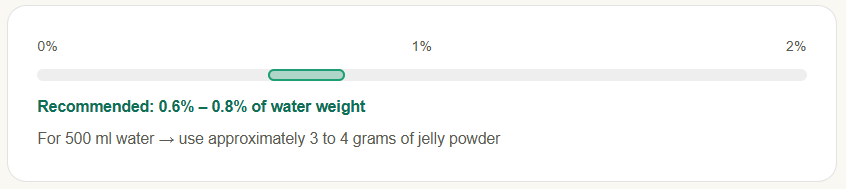
Getting the ratio right is essential — too little and your jelly won’t set; too much and it will turn rubbery. The industry-recommended dosage for standard jelly powder is:
Practical tips for best results
Always bloom the powder in a small amount of cold water first (about 5× the powder’s weight), then heat to fully dissolve before adding to your main liquid. This prevents clumping and ensures a smooth, evenly set gel.
For fish gelatin powder, the same blooming technique applies. Because it is flavorless, you can substitute the water with fresh juice, coconut milk, coffee, or any liquid of your choice — making it far more versatile than standard jelly powder for creative recipes.
06 · Decision
Which one should you choose?
Choose jelly powder if you want:
Speed and simplicity. Jelly powder is pre-flavored, so you just dissolve it and chill. It’s great for kids’ desserts, everyday jellies, and situations where you want a consistent result without having to think about flavor ratios. Products made with carrageenan-based jelly powder also tend to have excellent visual clarity.
Choose fish gelatin powder if you want:
Creative control and cleaner ingredients. Because fish gelatin contains no flavors, colors, or preservatives, you decide exactly what goes in. You can make matcha milk jelly, passionfruit panna cotta, cold brew coffee jelly, or anything in between. It’s also more economical — you use less per gram of liquid — and is the standard ingredient used in professional patisserie for mousses and mirror glazes.
<strong>Note</strong>
Fish gelatin is a pure protein with zero fat and no starch. It is naturally low-calorie and rich in collagen, making it a genuinely nutritious ingredient rather than just a texture additive.
07 · FAQ
Frequently asked questions
Is fish gelatin the same as jelly powder?
Not exactly. Jelly powder is essentially a pre-mixed product that uses a gelling agent (often carrageenan or fish gelatin) as its base, plus added flavors and colors. Plain fish gelatin powder contains only the protein extract — no additives at all. They’re often confused because some brands market fish gelatin as “jelly powder,” so always read the ingredient list.
How much jelly powder should I use?
The recommended usage is 0.6%–0.8% of the total liquid weight. In practical terms, for every 500 ml of water, you would use approximately 3–4 grams of jelly powder. Start at the lower end (0.6%) for a softer, more tender jelly, and increase slightly for a firmer, sliceable result.
ry milk, plant-based milks, coffee, matcha tea, and more. One important caveat: certain fresh tropical fruits (pineapple, papaya, kiwi, mango) contain enzymes that break down gelatin. If you want to use these, heat the juice first to denature the enzymes before adding your gelatin
Is fish gelatin healthy?
Yes. Fish gelatin in its pure form is purely protein — no starch, no fat, and virtually no calories. It is also a natural source of collagen peptides, which research suggests may support skin elasticity, nail strength, and joint health. Because it contains no preservatives or artificial additives, it is considered one of the cleaner gelling options available.
Can I use fish gelatin and jelly powder interchangeably?
With some adjustments, yes. If a recipe calls for jelly powder (which includes flavorings), and you’re using plain fish gelatin instead, you’ll need to add your own sweeteners and flavoring liquids. The gelling ratio may also differ slightly depending on the brand and bloom strength of your gelatin. A starting ratio of 1 teaspoon of fish gelatin per 250 ml of liquid works for a medium-firm set.
What is the best liquid to pair with fish gelatin?
Almost anything works — fruit juice, coconut milk, plant-based milks, coffee, matcha tea, and more. One important caveat: certain fresh tropical fruits (pineapple, papaya, kiwi, mango) contain enzymes that break down gelatin. If you want to use these, heat the juice first to denature the enzymes before adding your gelatin.