

In the food processing, pharmaceutical capsule manufacturing, and photosensitive material industries, viscosity is one of the most critical physical indicators for assessing the quality of gelatin. Understanding the variables that influence gelatin viscosity is essential for precisely controlling product performance. This article will provide an in-depth analysis of the core factors affecting gelatin viscosity from five dimensions: concentration, temperature, pH value, time, and salts.

1. Concentration: Positive Correlation Effect
The viscosity of gelatin solution is significantly and positively correlated with its concentration.
- Physical mechanism: As the concentration increases, the distance between gelatin molecules decreases, increasing the probability of entanglement and collision between molecular chains, and consequently increasing the internal friction.
- Industry standard: Internationally, a concentration of 6.67% is commonly used as the standard testing condition (Bloom Value test).
- Application implications: In the preparation process, excessively high concentrations lead to poor solution fluidity and difficulty in pumping; excessively low concentrations result in insufficient film-forming properties or suspending power.
- Physical Mechanism: As concentration increases, the distance between gelatin molecules shortens, leading to an increased probability of entanglement and collision among molecular chains, thereby increasing internal friction.
2. Temperature: Sensitive Inverse Relationship
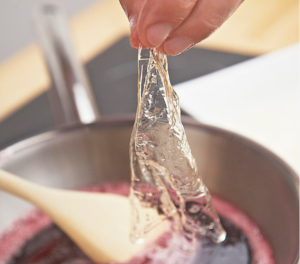
Temperature is the most dynamic variable affecting gelatin viscosity, with its impact typically being dramatic.
- Thermal Motion Law: As temperature rises, molecular thermal motion intensifies, weakening intermolecular forces and significantly reducing viscosity. For example, increasing the temperature from 10°C to 40°C can result in a viscosity reduction of over 50%.
- Irreversible Risk: It is crucial to strictly monitor heating time. When the temperature exceeds 50°C and persists for an extended period, gelatin undergoes thermal degradation, causing permanent viscosity loss that cannot be recovered even after cooling.
3. pH Value: Influence of Isoelectric Point
The charge state of gelatin molecules directly affects their degree of extension in the solvent.
- Peak Range: Gelatin viscosity reaches its highest value near the isoelectric point (pI, typically pH 4.7-5.2)。
- Stability Range: Within the pH range of 6.5-9.0, gelatin exhibits good chemical stability and solubility, with minimal viscosity variation.
- Extreme Conditions: When pH exceeds 11.5, the molecular structure of medium- to high-viscosity gelatin is disrupted, leading to a sharp decline in viscosity.
4. Time: Dissolution and Equilibrium Process

Gelatin does not instantaneously reach equilibrium in its physical properties.
- Hydration Process: After gelatin is dispersed in cold water and heated to dissolve, the molecules require time for hydration and chain segment reorganization.
- Peak Attainment Period: Typically, solution viscosity gradually increases to its peak within 24 hours after preparation. After this period, if the temperature remains constant and there is no microbial interference, viscosity enters a stable phase.
5. Salts and Molecular Sources (Salts & Sources)
The addition of electrolytes alters the hydration layer of gelatin molecules.
- Influence of Salt Valence:
- Monovalent salts (e.g., NaCl): Have minimal impact, maintaining good water solubility.
- Divalent salts (CaSO₄): Have a moderate impact.
- Trivalent salts (e.g., Fe₂(SO₄)₃): Tend to form insoluble salts, causing a significant decrease in viscosity.
- Raw Material Source: Gelatin viscosity also originates from its natural genetic makeup. Bovine bone gelatin (ossein gelatin) typically has a higher molecular weight and stronger viscosity than acid-processed gelatin; whereas gelatin derived from pigskin, bovine hide, and fish scales exhibits varying viscosity characteristics under the same conditions due to differences in collagen cross-linking structures.
Summary
To achieve stable viscosity performance in practical applications, it is recommended to:
Strictly control heating temperature to avoid exceeding 50°C.
Maintain the solution’s pH within the stable range of 6.5-9.0.
Allow sufficient hydration time to ensure complete molecular extension.