

In the gelatin industry, the Bloom value (gel strength) stands as the most core physical indicator for assessing product quality. It not only defines the firmness of the gel formed by gelatin but also directly determines the final product’s texture, stability, and mechanical strength.
This article will elucidate the practical significance of the Bloom value and guide you on how to make the best choices in different application scenarios.
What is the Bloom Value?
The Bloom value (Gel Strength) refers to the force (in grams) required to press a plunger with a diameter of 12.7 millimeters 4 millimeters deep into a gel formed by a gelatin solution at a standard concentration of 6.67% cooled for 17 hours at 10°C.
- Higher values: Indicate a denser gel network, stronger elasticity, and faster setting speed.
- Lower values: Result in a softer gel texture, greater viscosity, and easier dissolution.
Based on the range of Bloom values, gelatin plays vastly different roles across various industries.

Food Industry: Bloom Value Shapes Diverse Textures and Qualities
In food manufacturing, the Bloom value directly influences consumers’ sensory experiences:
On the stage of the food industry, gelatin, with its unique gelling properties, has become an indispensable ingredient in numerous culinary delights. The Bloom value determines the specific applications of gelatin in different food products.
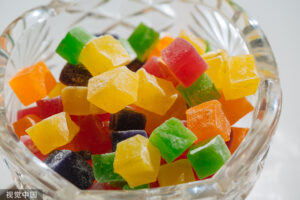
For foods that require high elasticity, such as gummy candies and aspic, gelatin with a high Bloom value (250 – 300) is the ideal choice. Gelatin with a high Bloom value forms a more robust gel network, imparting a chewy and smooth texture to gummy candies, allowing them to quickly regain their shape during chewing and providing a delightful eating experience. In aspic, high-Bloom-value gelatin ensures that the aspic forms a stable gel structure upon cooling, maintaining its integrity even after being cut and transported without easily breaking.
Conversely, for soft desserts like mousse and dairy products that require thickening, gelatin with a low Bloom value (50 – 150) is more suitable. Gelatin with a low Bloom value forms a relatively soft gel, lending a delicate and silky texture to mousse, making it melt in the mouth. In dairy products, low-Bloom-value gelatin acts as a thickening agent, improving the texture of dairy products, making them thicker and richer while not affecting their original flavor.
Pharmaceutical Field: Bloom Value Ensures Drug Quality and Efficacy
In the pharmaceutical sector, gelatin is also widely and critically applied, with the Bloom value being a crucial factor in ensuring drug quality and efficacy.
Capsule shells are one of the most common applications of gelatin in the pharmaceutical field. To ensure that the capsule shells dissolve on schedule in the gastrointestinal tract to release the internal drugs while possessing sufficient mechanical strength to prevent breakage during storage and transportation, gelatin with a Bloom value of 150 – 250 is typically used. This medium-Bloom-value gelatin strikes a balance between solubility and mechanical strength, ensuring the stable quality of capsule shells.
Hemostatic sponges are another important application of gelatin in the pharmaceutical field. During surgical or traumatic hemostasis, hemostatic sponges need to rapidly form a gel to block the wound and stop bleeding. Gelatin with a high Bloom value (>300) can provide better structural support, forming a more robust gel that can more effectively withstand the pressure at the wound site, preventing blood exudation and thus improving hemostatic effects.
Other Applications: Bloom Value Expands the Infinite Possibilities of Gelatin

Besides the food and pharmaceutical fields, gelatin also finds extensive applications in other industries, where the Bloom value also plays a significant role.
In the photographic film industry, gelatin with a medium to high Bloom value is used for the adhesion of photosensitive emulsions. The gel formed by medium-to-high-Bloom-value gelatin exhibits good adhesion and stability, enabling it to uniformly attach the photosensitive emulsion to the film base, ensuring accurate recording of image information during shooting while guaranteeing the quality and stability of the film.
In the cosmetics industry, gelatin with a low Bloom value is often used as a mild gel base for moisturizers. The gel formed by low-Bloom-value gelatin has a soft texture, being gentle and non-irritating to the skin. It can provide moisturizing and hydrating effects to the skin while also serving as a carrier for other active ingredients, delivering nutrients to the deeper layers of the skin and enhancing skincare efficacy.
Summary of the Significance and Applications of the Bloom Value
Gelatin with a high Bloom value (e.g., 250 – 300 Bloom) features a more robust gel network and excellent elasticity. This makes it outstanding in manufacturing hard capsules with high mechanical strength requirements, ensuring that the capsules remain undamaged during storage and transportation. Meanwhile, for specific dosage forms that require strong shaping capabilities, such as certain sustained-release drug formulations, high-Bloom-value gelatin can also provide reliable support, guaranteeing the stable release of drugs.
Gelatin with a low Bloom value (e.g., below 150 Bloom) forms a relatively soft gel. This makes it highly suitable as an adhesive and coating material, providing necessary adhesion and protection to products without affecting their performance. For gel bases with low toughness requirements, such as some gel masks in cosmetics, low-Bloom-value gelatin can offer a more gentle and comfortable user experience.
Gel strength (Bloom value) is the key code to unlocking the application performances of gelatin products. Different industries have varying demands for gelatin. By reasonably selecting gelatin with different Bloom values, we can fully leverage the advantages of gelatin to meet the needs of various industries, including food, pharmaceuticals, photography, and cosmetics, bringing more convenience and beauty to people’s lives. When choosing gelatin products, understanding the significance and applications of the Bloom value will help you make wiser decisions and provide strong guarantees for the quality and performance of your products.
3 thoughts on “The Ultimate Guide to Gelatin Bloom Strength: Choosing the Right Gel Strength for Your Application”
Pingback: 3 Key Factors Affecting the Gelatin Strength - Gelatin Supply - Edible&Medicinal Gelatin
Gelatin’s strength is a crucial indicator of its resistance to deformation or breakage after gelation, directly impacting its performance in food, pharmaceutical, and other fields. This indicator must be considered when purchasing and selecting gelatin.
Pingback: Advanced Hemostatic Solutions: The Vital Role of Pharmaceutical-Grade Gelatin in Surgical Bleeding Control - Gelatin Supply - Edible&Medicinal Gelatin