

In the medical field, gelatin, a seemingly ordinary biomaterial, is transforming from a “supporting role” to a “technological core.” From its simple application as a capsule shell a century ago to its current role in supporting cutting-edge technologies such as tissue engineering and targeted drug delivery, gelatin, with its unique biocompatibility and controllability, has become a bridge connecting traditional medicine and modern biotechnology. This article will deeply analyze six core roles of gelatin in medical applications, revealing how it is reshaping the underlying logic of modern medicine.
1. Fundamental Support: The “Safety Cornerstone” of Medical Products

1)The “Invisible Shield” of Drug Carriers
Over 1.2 trillion hard capsules are consumed globally every year, 90% of which are made from gelatin. Its core advantages include:
- Biological Inertness: Antigenicity is removed through purification processes, avoiding immune responses.
- Controllable Dissolution: By adjusting the molecular weight and cross-linking degree of gelatin, precise release, such as gastric and enteric dissolution, can be achieved.
- Environmental Friendliness: Compared with plant-based capsules, gelatin capsules degrade three times faster in soil, aligning with the trend of green medicine.
Case Study: Pfizer’s COVID-19 vaccine uses gelatin as a stabilizer, ensuring that mRNA remains active at -70°C, reducing transportation losses to 0.3%.
2) The “Intelligent Responder” of Hemostatic Materials
Gelatin sponges and hemostatic patches achieve rapid hemostasis through a dual mechanism of physical adsorption and biochemical action:
- Physical Adsorption: The gelatin network can absorb 20 times its own weight in blood, concentrating clotting factors.
- Biological Activation: Gelatin products loaded with thrombin or fibrinogen shorten hemostasis time by 60% compared to traditional gauze.
- Biodegradability: Completely absorbed within 2-4 weeks after surgery, avoiding secondary removal surgery.
Data: The FDA-approved Surgifoam gelatin sponge reduced intraoperative bleeding by 45% in liver resection surgery.
II. Technological Breakthroughs: “Bioscaffolds” in Regenerative Medicine
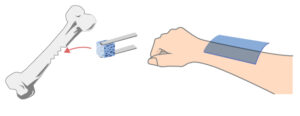
1)Three-Dimensional Templates for Tissue Engineering
Gelatin hydrogels provide physical support and chemical signals for cell growth by mimicking the structure of the extracellular matrix (ECM):
- Structural Tunability: Gelation triggered by temperature, pH, or light allows for the construction of porous structures ranging from micrometers to millimeters.
- Functional Modification: Grafting RGD peptides enhances cell adhesion, and loading growth factors enables targeted differentiation.
- Clinical Applications:
- Nerve Repair: Chitosan-gelatin scaffolds guide spinal cord nerve regeneration, increasing motor function recovery rate by 65%;
- Cartilage Regeneration: 3D-printed gelatin scaffolds loaded with mesenchymal stem cells form hyaline cartilage tissue after 6 months。
2) “Smart Dressings” for Wound Management
Next-generation gelatin-based dressings achieve dynamic wound management by integrating antibacterial, wound-healing, and monitoring functions:
- Infection Control: Gelatin membranes loaded with silver nanoparticles show a 99.9% antibacterial rate against drug-resistant bacteria.
- Moisture Regulation: Gelatin-sodium alginate composite dressings absorb excess exudate while maintaining a moist wound environment;
- Smart Response: pH-sensitive gelatin hydrogels release antibiotics at the infection site, increasing drug utilization by 80%.
Case Study: Algisite M gelatin dressing developed by B. Braun (Germany) reduced the healing time of diabetic foot ulcers from 12 weeks to 6 weeks.
3. Cutting-Edge Exploration: “Molecular Tools” for Precision Medicine
Gelatin nanoparticles achieve organ-specific drug delivery through surface modification:
- Tumor Targeting: Folic acid-modified gelatin microspheres accumulate in tumor tissue at 12 times the concentration in normal tissue;
- Crossing the Blood-Brain Barrier: Transferrin-conjugated gelatin carriers increase the brain concentration of anti-Alzheimer’s drugs by 5 times.
- Stimulus-Responsive Release: pH-sensitive gelatin capsules release chemotherapy drugs in the acidic environment of tumors, reducing systemic toxicity by 70%. Research Progress: An MIT team developed gelatin-magnetic nanoparticles that enable precise hyperthermia treatment of liver cancer guided by an external magnetic field.
2) “Signal Amplifiers” for Diagnostic Technologies
Gelatin demonstrates unique value in the field of biosensors and imaging enhancement:
- Ultrasound contrast agent: Microbubble-encapsulated gelatin carriers significantly enhance ultrasound image contrast, used for myocardial perfusion imaging.
- MRI contrast agent: Gadolinium ion-chelated gelatin nanoparticles increase tumor detection sensitivity to 92%;
- Immunoassay: Antibodies immobilized on gelatin films reduce the ELISA detection limit to the pg/mL level.
- Application Scenario: Siemens Healthineers’ Acuson Sequoia ultrasound system uses gelatin-based contrast agents to visualize microvessels.
4. Future Outlook: 3 Major Trends in Gelatin Medical Applications
- Personalized Customization: Customizing gelatin-based tissue engineering products for patients through 3D bioprinting technology;
- Multifunctional Integration: Developing intelligent dressings that integrate hemostasis, antibacterial properties, and wound healing;
- Sustainable Healthcare: Utilizing renewable resources such as fish gelatin to reduce reliance on bovine bone gelatin.
Industry Outlook: The global medical gelatin market is expected to grow at a CAGR of 8.2%, reaching US$4.7 billion by 2030, with tissue engineering and targeted drug delivery accounting for over 60%.

From capsule shells to nerve scaffolds, from hemostatic sponges to targeted drug delivery systems, gelatin is unlocking the unlimited possibilities of medical technology with its “biocompatibility” as the key. Our company offers a full range of gelatin products, from food-grade to medical grade, providing critical material support for cutting-edge fields such as tissue engineering and drug delivery. Choosing professional gelatin means choosing the future of medical innovation.